The Missing First Cheque: Why African Pre-Seed Keeps Shrinking

Aurore Beuque
September 8, 2026
123
Why write this now? Because a paradox has nagged at me. AI is making it dramatically cheaper and faster to start a company, and yet the very first rung of African startup financing keeps thinning. I felt the paradox firsthand: when Digital Africa ran an AI Startup Challenge out of Nairobi last May, I braced for a modest response. Instead, we received more than 400 applications from 40 countries, several that had never once appeared in our pipeline before. The talent and the ambition are plainly there, and spreading. So why is the money at the very first step drying up? This piece is my attempt to answer, honestly and with the data. One acknowledgement before I begin: little of what follows would be possible without “Africa: The Big Deal”, whose patient, deal-by-deal compilation of the continent’s fundraising is what makes analysis of this kind possible at all.
In January, I wrote in these pages that the foundation of African early-stage financing was eroding. The first half of 2026 settles the question. The continent raised $1.36 billion, flat in value. But the number of startups raising at least $100k fell to 190, the lowest since 2021, and rounds between $100k and $1 million dropped from 179 to 100 in six months.1
The instinctive explanation is AI: a handful of model companies absorbing the capital and starving everything else. The reading is tempting, because AI dominates the headlines. It is also wrong, and the distinction matters, because the remedy depends on the diagnosis. One caveat first, borrowed from Ido Sum: nothing that follows describes a broken ecosystem. Africa is early in its technology history, roughly where the United States stood in the 1970s or India in the early 2000s. The useful question is not whether the ecosystem works. It is what this contraction reveals about what it still lacks.
Two findings frame the rest of this piece. First, fewer startups are entering the funnel every year, and once inside, graduation rates have fallen for every cheque size, not just the smallest. Second, when I classified, by hand, every startup that raised in H1 2026, AI took only about a seventh of the money, and barely 2% went to genuinely AI-native companies. The AI wave that supposedly explains the squeeze is, on the continent, still small and cheap to fund.
Start with what should logically be happening. AI lowers the cost of building. In the United States, new-business applications are up by roughly a fifth since late 2022, and the median seed-stage team has gone from five people to four.2 Read this as correlation, not cause; formation has many drivers, but the direction is clear: cheaper, leaner, faster should produce more startups and more small first rounds.
The opposite is happening, and everywhere. Pre-seed is down roughly 40% in Latin America, seed is down about 63% in Southeast Asia and 30% in India, each on a 2025-versus-2024 basis, while in Africa first cheques of $100k to $500k have more than halved since their 2021 peak.3 The comparison windows differ, so treat them as a shared direction rather than like-for-like magnitudes. Easier to start a company, harder to raise the first round: that is the real paradox, and it points to something more powerful than the democratisation of building, a change in how capital is allocated.
Global capital is retreating into a handful of hands. Megafunds above $1 billion — including Andreessen Horowitz, General Catalyst and Thrive Capital — captured around 72% of deal value in H1 2026, against 25% a year earlier; separately, five funds took close to three-quarters of new capital raised over the year.4 The first figure is about where money is deployed, the second about where LPs place it; two distinct facts, both pointing the same way. At the other end, emerging managers, the people who write first cheques, are at their weakest in a decade.
This is not a passing accident of the cycle. Philippe Aghion has shown that every technological revolution, from steam to electricity to computing and now AI, begins by concentrating value among those able to mobilise very large fixed investments, and in doing so discourages new entrants5. Concentration is the signature of a phase, not a malfunction. Which is precisely why it cannot be left alone in Africa: if the phase is universal, the capacity to survive it is not. Mature ecosystems ride out a concentration cycle on shock absorbers built over decades. Africa is entering this one without them. That asymmetry, not AI, is the subject of this piece.
AI, in this reading, is the destination rather than the cause. It absorbs a large share of seed dollars6, but the mechanism starving the top of the funnel is that money now travels through fewer funds, into fewer companies, in larger cheques, at the expense of the many small rounds that constitute a pipeline. Ido Sum, working from the same database, has surfaced a second possible effect: the strongest predictor of a startup graduating from one round to the next is neither sector nor geography, but the number of investors in the round, and the median African syndicate shrank from two to one during the 2020-2022 boom. I tried to reproduce the effect on pre-seed rounds alone and could not, most likely because syndicate composition is thinly documented at that stage and the sample is small. Treat it as established for early-stage rounds broadly, and suggestive at pre-seed.
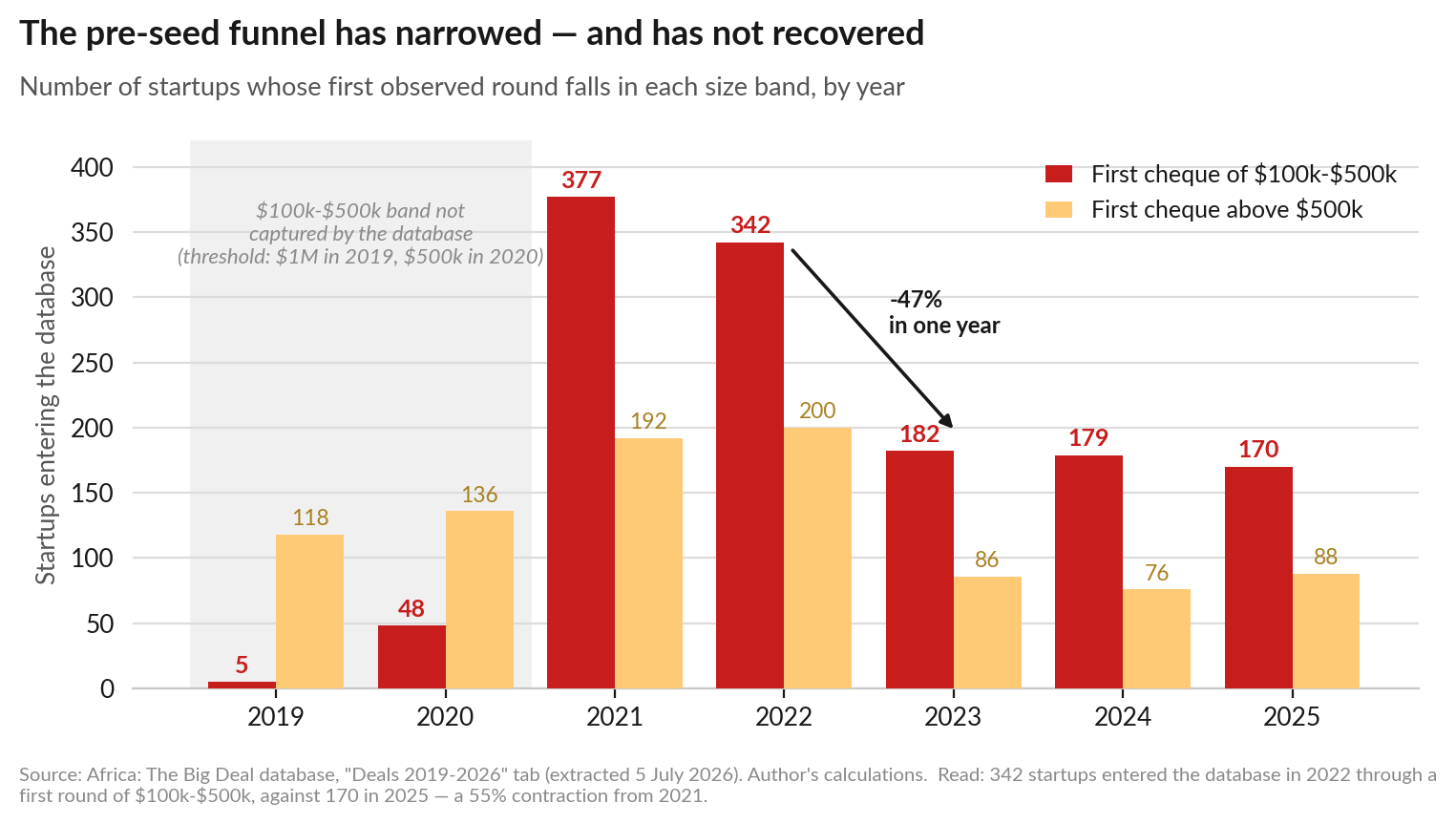
The concern I raised in January was a pipeline problem. A first cheque is the mouth of a pipe: it has to feed larger rounds later. Two questions follow. How many startups get that first cheque? Fewer every year. The number entering through a $100k to $500k ticket fell from 377 in 2021 to 170 in 2025, a 55% decline with no rebound.78
Do those who received one progress as they used to? Crossing the next threshold, raising more than $1 million, was always rare and has become rarer: 18% of the 2021 entry cohort managed it within three years, against 8% of the 2022 cohort. But that deterioration is not specific to small cheques. It hit every ticket size, and hit the larger ones harder: between 2021 and 2023, graduation probability fell 7.7 points for small tickets and 17.7 points for the $500k to $1 million band. The capital squeeze draining pre-seed is in fact compressing the entire early stage, the bottom and the middle of the chain alike.
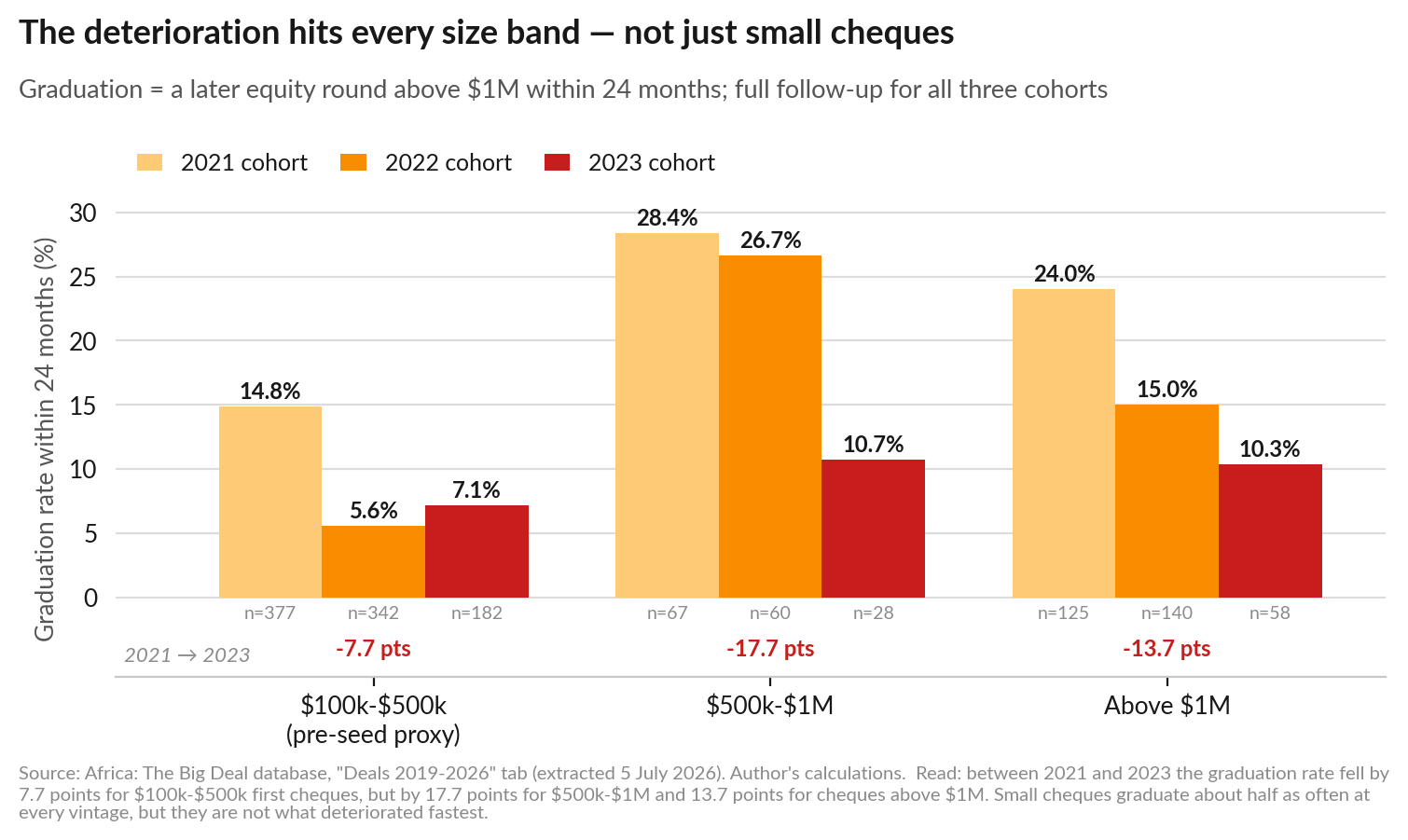
One methodological limit: the database cannot see startups that were never funded or merely confidential, so this is not evidence that any given company’s odds have worsened. What it shows is a pipe narrowing at the mouth and a follow-on market tightening for everyone inside it.
The obvious objection deserves a direct answer. If graduation is deteriorating across the board, and if the Series A to B transition in Africa runs at roughly 17% against 50 to 65% in the United States9, why insist on funding the entrance? The constraint is genuinely further up, and I would not argue otherwise. But the two problems are not substitutes, because they have different remedies. A weak conversion rate is a coordination and company-building failure: it responds to syndication, to follow-on reserves, to operational support, to investors agreeing to carry the strongest names in each portfolio through a hard market, the purpose of initiatives like Africa Next, built with AfricaGrow and Bpifrance to strengthen early-stage co-investment10. An empty cohort responds to nothing: you cannot improve the conversion rate of companies that were never funded, and a thinner top compounds mechanically into a Series A class three years out. Fixing the middle is urgent. It does not make the entrance optional.
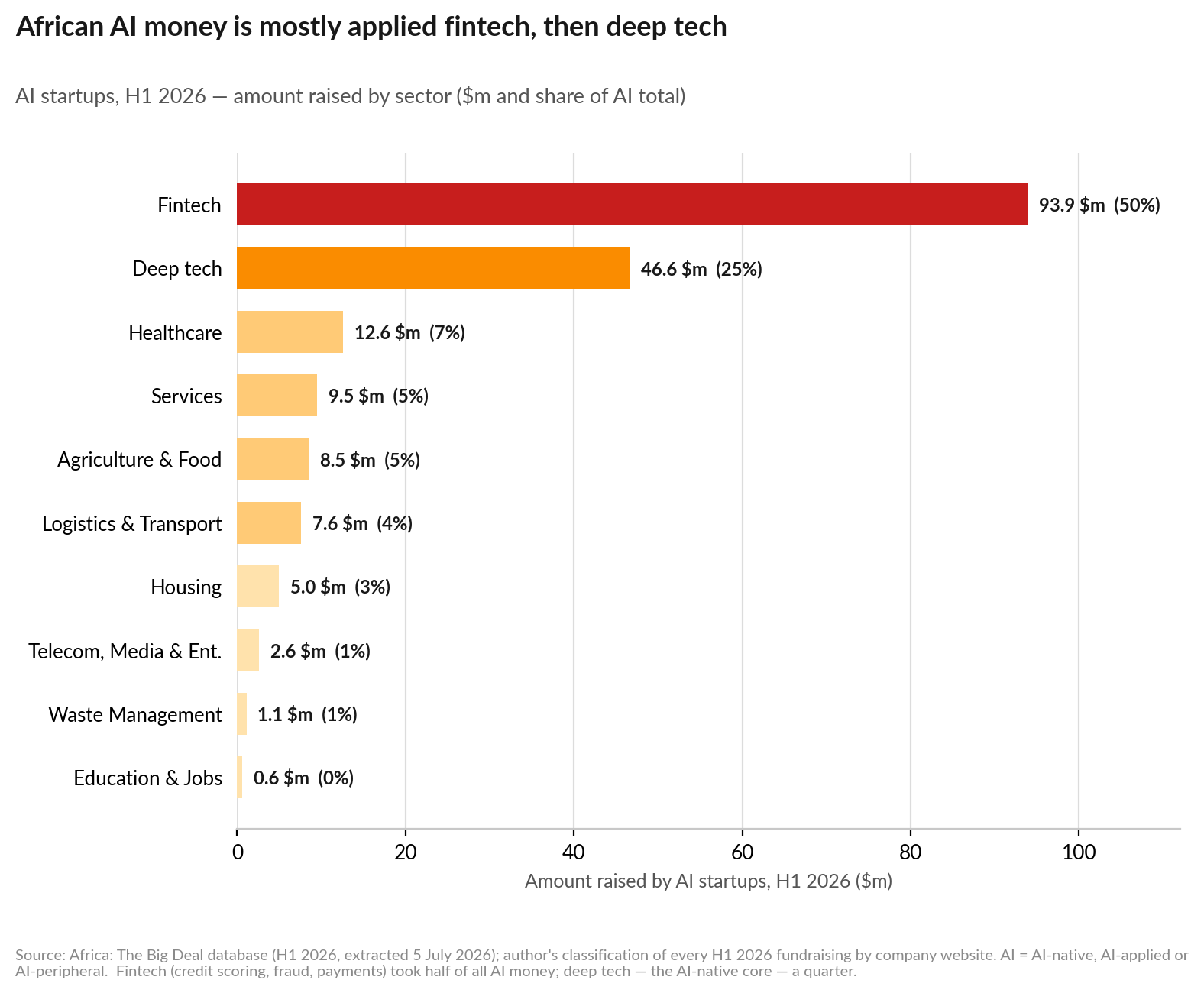
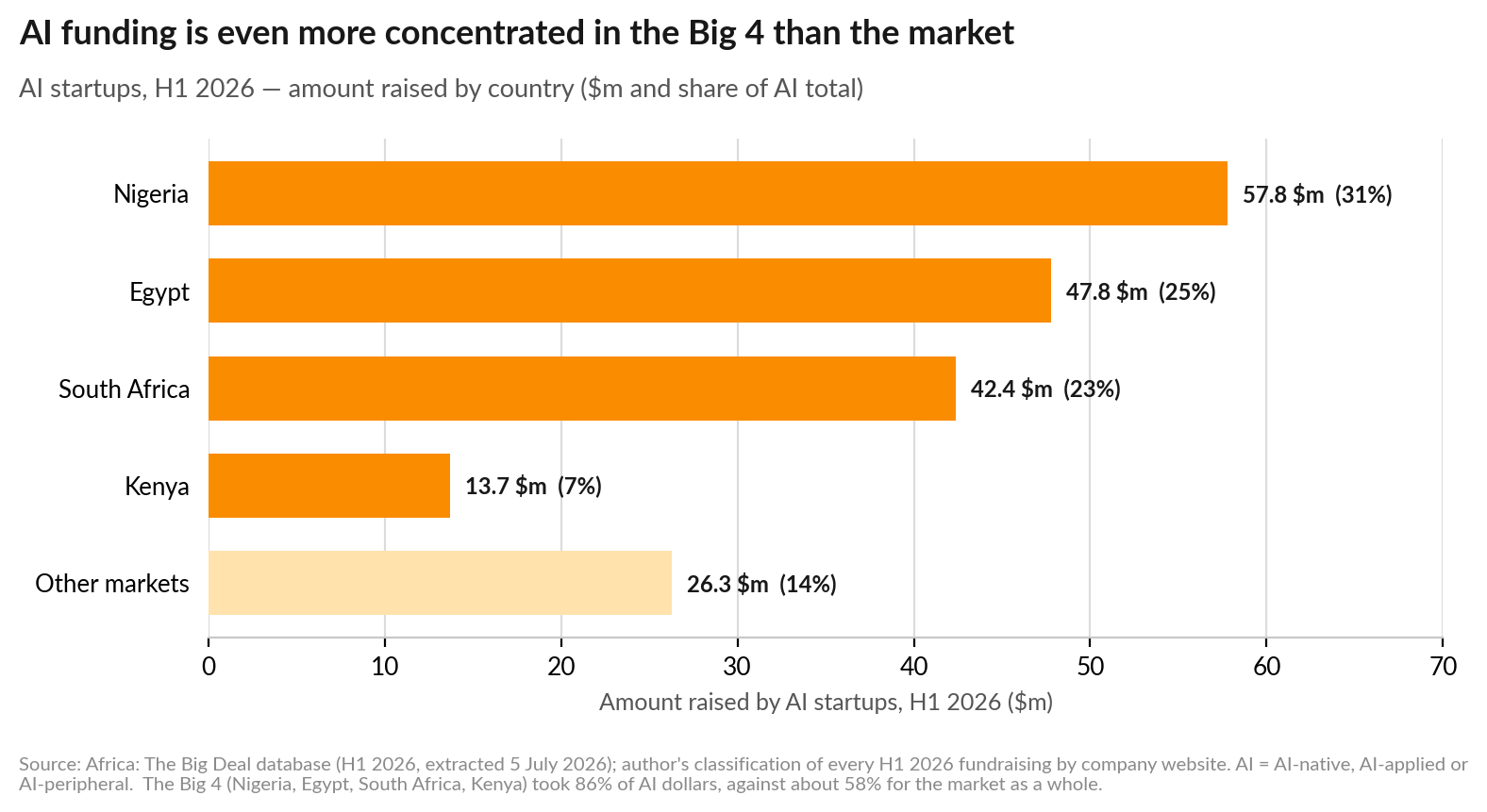
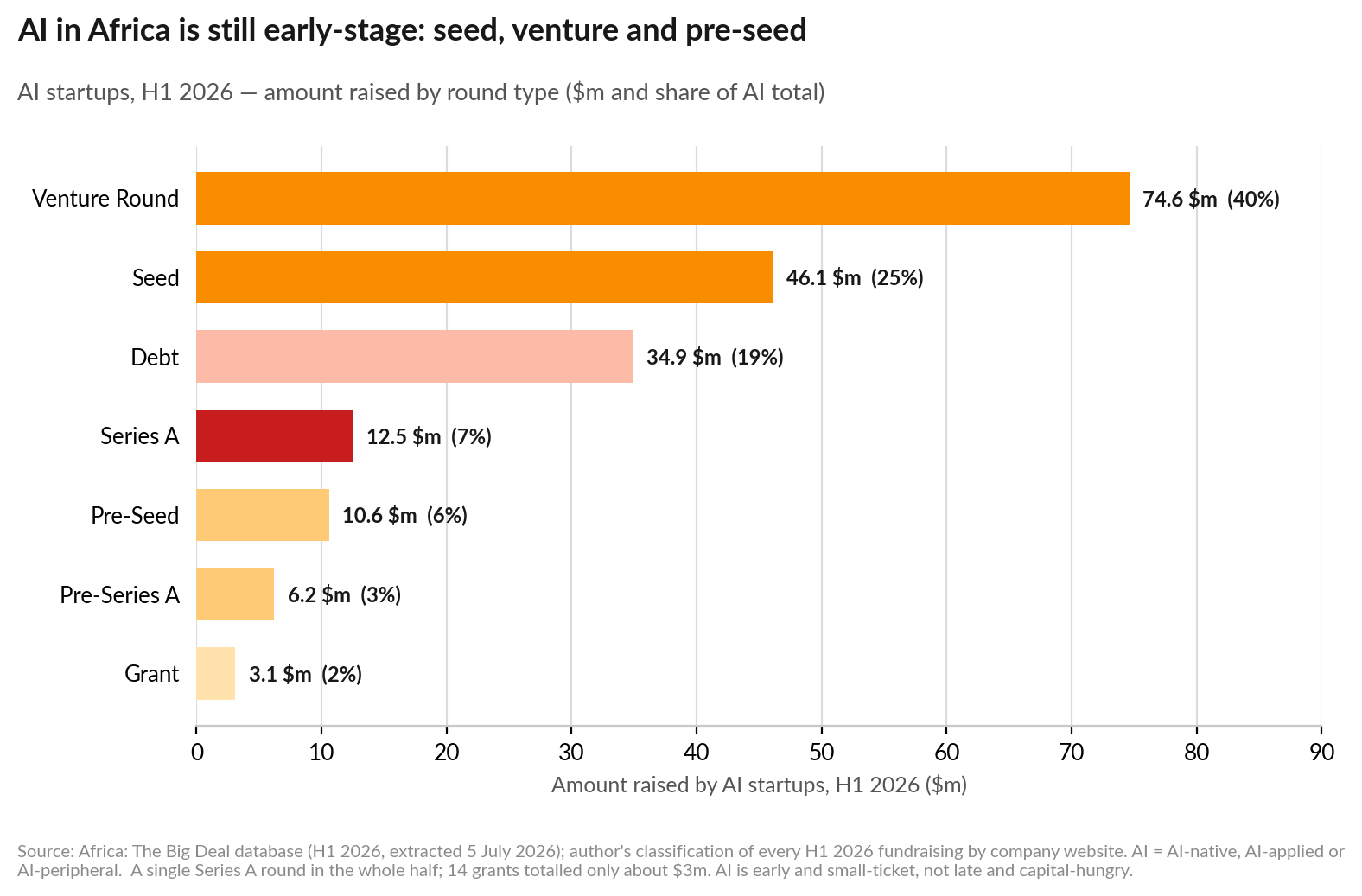
Is AI actually big on the continent, and is it the capital-hungry, AI-native kind? To answer without leaning on the database’s own description field, I classified every startup that raised in the first half of 2026, 194 in all, by checking each company's website (thanks to the help of AI tools). The result is striking: AI companies of any kind took about 14% of the money raised, and genuinely AI-native ones just under 2%11. Far from absorbing capital, AI on the continent is still a small and mostly applied slice of it — the mirror image of the global picture, where AI now commands a large share of seed dollars. And the AI-native founders that do exist raise less, not more: they run on teams about half the size of their peers, a median of 11 against 16 to 22, and take a slightly smaller first cheque.12 They are not hypothetical: Sinai.ai is building an LLM-based reading companion in Egypt, ToumAI works on generative multilingual voice analysis in Morocco, Aya Data in Ghana prepares training data, YarnGPT synthesises speech in Nigerian languages, DeepEcho reads foetal ultrasound in Morocco, and Signvrse in Kenya built a sign-language translator on about $20,000 of early capital13. And the shape of that money is telling: about half went to fintech, AI used for credit scoring, fraud and payments, and a quarter to deep tech, mostly at seed and pre-seed, with a single Series A among them, Blnk, an Egyptian embedded-lending platform. It is also more concentrated in the Big 4 than the market as a whole: 86% of AI dollars, against 58% overall14.
One reservation. AI lowers the cost of the product, not the cost of the market or of the local knowledge that gives the product its value, which remains slow and expensive to acquire. As Ido Sum puts it, the defensible asset in Africa is neither compute nor the model but the ability to read data nobody was reading15. Falling build costs do not remove the need for patient capital; they move what it buys. And some of these founders belong to a category worth naming: the company built in Africa and sold to the world, on the model of InstaDeep or Moove16. Demonstrating that the continent can produce champions sold globally, on the same terms as American, Asian or European ones, is an objective in itself, and one of the surest ways to manufacture the exits that feed everything downstream.
What Africa lacks is buffers, not entrepreneurs
If the contraction is global, why worry more about Africa? Because other ecosystems absorb the shock on structures Africa has not yet built.17
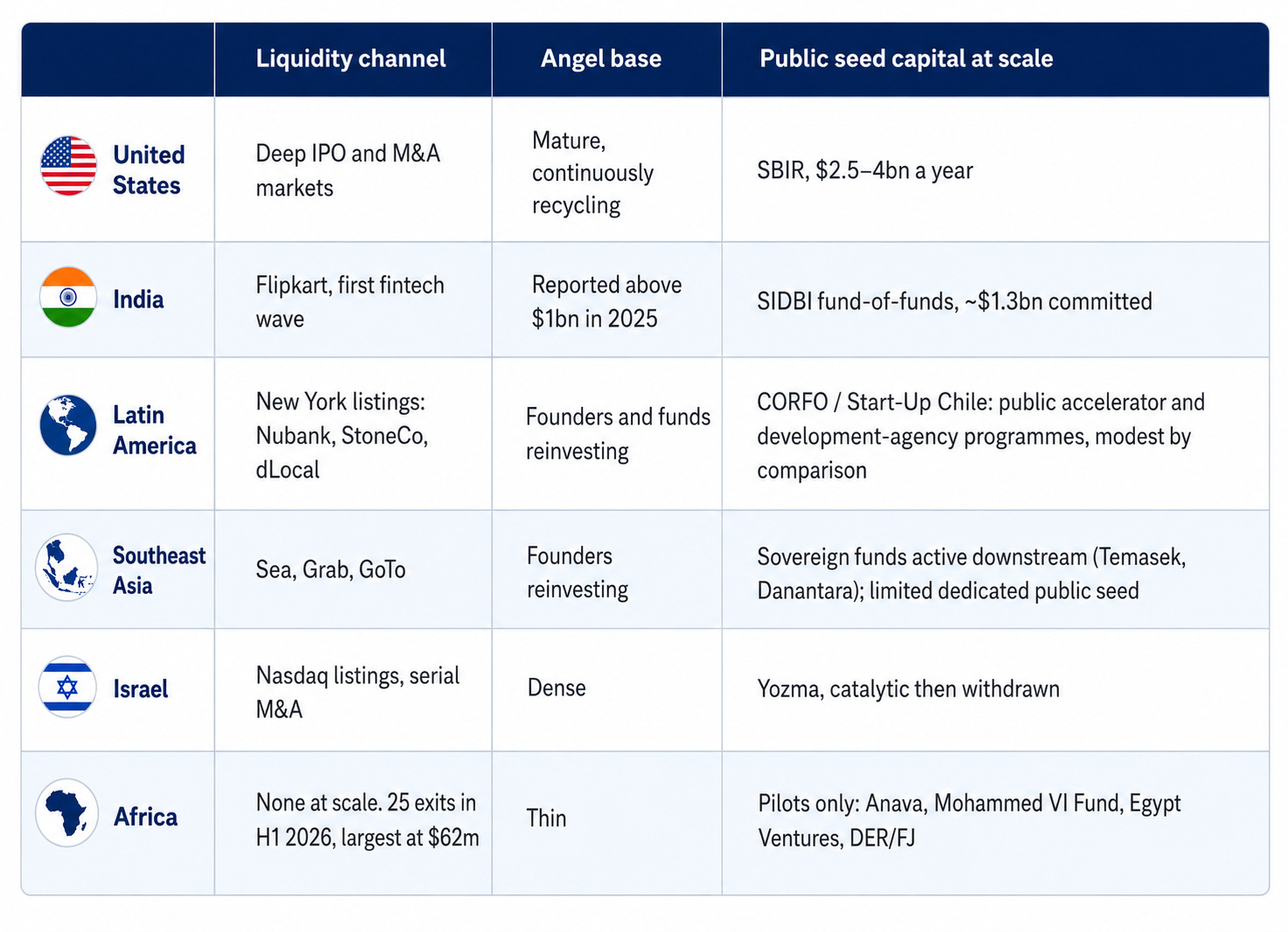
The first buffer is an angel base fed by exits, each region building its own through a liquidity channel of its own; Africa has none at scale yet. The second is public seed capital of consequence. The orders of magnitude tell the story: SBIR deploys $2.5 to $4 billion a year, India’s SIDBI fund-of-funds has committed close to $1.3 billion, and Israel’s Yozma catalysed a multiple of its initial capital. Bpifrance’s Fonds National d’Amorçage showed a similar leverage effect in France, with €1 of public money associated with up to €18 raised later18. Africa has nothing comparable, only a few valuable pilots. Elsewhere, a virtuous cycle took hold: exits create angels, angels fund the top of the funnel, and the state multiplies them. In Africa, exits stay rare, the investor pool is shrinking, and public seed capital remains embryonic.
There is a third buffer I did not discuss in January, and it may matter most, because it is the only domestic capital pool at scale: African institutional investors. The continent's pension and insurance assets run into the hundreds of billions of dollars, South Africa alone above $300 billion, Kenya about KSh2.8 trillion, yet very little of it reaches the emerging managers who write first cheques. The gap is now measurable: development-finance institutions still supply about 42% of commitments to Africa-focused private-capital funds, down from 59% in 2022, while African pension funds, insurers and corporates, rising fast, from $171 million in 2022 to $639 million in 2024, remain only about a sixth of the total, and thinner still at the venture end19. Kenyan schemes may allocate up to 10% to licensed private equity and venture; they sit near 1%. Nigeria long capped private equity and infrastructure near 5%. AVCA estimates Ghana’s pension funds alone could unlock around $1 billion for private capital if fully leveraged20. The encouraging part is that the rules are moving: South Africa’s Regulation 28 lifted the private-equity ceiling from 10% to 15% in 2022, Nigeria’s PenCom raised its private-equity limits and tightened the criteria in September 2025, and Namibia’s Regulation 29 goes further, mandating a share of local institutional capital into domestic unlisted assets. In most markets, the binding constraint is now familiarity and intermediation, not law. As long as first-cheque funds depend on foreign development capital, Africa’s entrance to venture will re-import every shock in the global cycle; mobilising even a sliver of this domestic pool would change the arithmetic.
A fourth constraint is regulatory, and mostly unspoken. It is not that the law forbids early-stage equity. Investors have been writing SAFEs and convertible notes in these markets for years; the point is that they do so outside the framework rather than within it. OHADA’s 2014 reform did modernise the toolkit, with the SAS, preference shares and composite securities, but a SAFE remains a contract rather than a recognised security: valid between the parties, untested before the courts, and convertible only through a full capital increase voted later, with its extraordinary general meeting, its authenticated deed, its registry filing and its registration duties. The one statutory instrument that would remove the doubt, the convertible bond, is reserved to companies with two years of existence and two approved sets of accounts, that is, to companies that have stopped being pre-seed. So investors carry the gap themselves, and around it sit frictions of the same family: capital that moves only through exchange-control channels, investor rights worth exactly what the courts behind them are worth, no regulatory sandbox in either CFA zone, and a public buyer whose procurement code is written for incumbents. None of this is prohibitive. All of it is uncomfortable, and discomfort is expensive on a $50,000 cheque. It is why founders end up in Mauritius or Delaware, and why funds stay away from local vehicles. This bears directly on where the shortage bites hardest, outside the Big 4.
Africa depends on grant funding more than other emerging regions, for structural reasons: shallow capital markets, few angels for want of exits, and early-stage financing largely carried by development actors. Grants long served as the safety net. That net is being withdrawn: the grant share of pre-seed moved from roughly 18% in 2021 to about a third in 2024-2025, then to 15% in H1 202621, just as US aid is dismantled through the closure of USAID and cuts at USADF22. European relays, Germany’s DEG/GIZ matching programme, the UK’s PREO, and AFD via Digital Africa, offset only part of it and are themselves fragile: between sovereign-debt loads and the sudden expansion of defence budgets, European support is an uncertain foundation.
Two honest notes on those figures. The drop from a third to 15% in six months is almost certainly a reporting artefact rather than a real collapse, because grant awards are announced later than equity rounds; read the H1 2026 figure as provisional. And these numbers revise the ones I published in January, which put the grant share at 42% in 2025 against 20% in 2021: the revision reflects a fresh extraction with reclassified deals and a shift to a value-weighted measure; on a deal-count basis, the 2025 share is about 45%, close to the earlier figure. I also want to be explicit about a change of position. In January I treated grant dependence mainly as a discipline problem. I still think that holds as a steady state. But watching the net withdraw this fast has changed my view of the sequencing: you cannot remove the existing floor and build the replacement at the same time, and the transition itself is now the risk.
That capital concentrates on a few markets and a few names is not news. What is new is the degree. The share of the ten largest rounds in African equity went from 47% in H1 2025 to 66% a year later, and a single transaction, Spiro, accounted for close to a quarter of all equity in the half23. Concentration is no longer only geographic: it is collapsing onto an ever smaller number of cheques.
Faced with a market failure of this shape, catalytic public capital is legitimate, and the timing favours it. What follows is a working hypothesis rather than a recipe. Four convictions, more useful than the perennial public-versus-private argument. First, governance matters more than the identity of the shareholder: independence of the investment committee, performance incentives, speed, additionality, and a public stake that stays in the minority; co-financed companies do better when the public investor does not dominate24. Yozma is the model here, as Ido Sum has argued: public capital designed to seed networks and then withdraw, where donor money in Africa tends to settle in and invest alone.
Second, grants are not the enemy: well-selected, they produce real effects, and my own cohorts bear this out25. The task is to complement them with catalytic capital, not to replace them; impact should remain a measurable constraint rather than a substitute for viability, and public money should justify its additionality. Third, patience stated realistically: a few years for early signals, closer to ten for an ecosystem effect and for capital to recycle through founders who become angels. Fourth, delegated management with private-sector methods, cheques designed to seed shared rounds rather than solo positions, small patient tickets in the $20k to $100k range of the kind Fuzé deploys26, and enough ground-level judgement that the capital does not burn a round or two later.
Two things are true at once. African early-stage financing is genuinely short of money: the retreat of first cheques is nobody’s fault in particular, not the venture funds’, not their LPs’, not the development institutions’, and least of all the founders’; it is the product of a global concentration of capital. Much of this is a rational response to incentives. With a thinner pipeline and few exits, an allocator sensibly concentrates capital in established managers, broadening their reach rather than backing first-time or highly specialised funds, and on a continent where deal flow is too thin to sustain deep specialisation, and most managers are generalists, that logic bites hardest on precisely the emerging managers who would fund the entrance. The first cheques dry up not because anyone decided they should, but because every prudent investor, acting reasonably, retreats from the riskiest end at the same moment. And funding the entrance remains an imperative. And money alone will not be enough, because the weakness is also at the transitions, in the conversion from seed to Series A: that is where investor coordination, ecosystem-building, and public capital designed to seed shared rounds and then step back actually count.
Concretely, and to be clear about who I am asking: African governments and sovereign funds could each commit a first tranche to local emerging managers, on delegated management with a minority public stake, and measure additionality rather than disbursement. This is why no single kind of capital can carry it. Commercial LPs are right to prize stability and returns; that is their mandate, and the retreat from first cheques follows from it. Development finance answers to a second mandate, building the ecosystem itself, which is exactly why it, not private capital, should hold the entrance open now, taking the largest risks and the first losses. African pension funds, insurers and banks are the structural answer to imported volatility over the long run; but they cannot be rushed in before a track record exists. Until then, the decisive role falls to public capital able to take the largest risks and the first losses. Where regulation caps domestic institutional allocations, it can be raised; but that is a patient build, not a lever for today. And as DFIs and European donors cut grant budgets, they should protect the catalytic-equity line specifically: it is small, it builds a market rather than substituting for one, and it is the easiest to cut.
The continent has a window: AI lowers the cost of building, from Africa, companies sold to the world, the InstaDeep and Moove path, and those successes will manufacture the exits that eventually create the angel base still missing. African pre-seed is neither doomed nor close to healing on its own. It needs more capital at the entrance and an architecture that turns that capital into a market. That is the double task of the next few years, and it is largely in our hands.
African data and cohort analysis come from the “Africa: The Big Deal” database and my own calculations; other figures are sourced in the notes. Grant-share figures revise those published in January (see note). Thanks to Ido Sum, whose work on the same database informed several passages; the interpretations are mine. Disclosure: I am CEO of Digital Africa, which invests at the pre-seed stage in Africa and is therefore an interested party in the argument above.
1 Africa: The Big Deal, H1 2026 (thebigdeal.substack.com).
2 U.S. Census Bureau, Business Formation Statistics (business applications up roughly a fifth since late 2022); Carta, State of Pre-Seed 2025 (median seed team from five to four). These are correlations: business formation has several drivers beyond AI.
3 Latin America: Cuántico VP, LatAm VC Report 2026; Southeast Asia: DealStreetAsia; India: Entrepreneur India — each on a 2025-vs-2024 basis. Africa: author's cohort analysis of Africa: The Big Deal (first cheques of $100k-$500k, 377 in 2021 to 170 in 2025). The windows differ (annual for the first three, multi-year peak-to-latest for Africa): read them as a shared direction, not like-for-like magnitudes.
4 Two distinct metrics. Share of deal value: funds above $1bn represented about 72% of H1 2026 global deal value, up from 25% a year earlier (CNBC; PitchBook). Share of commitments: roughly three-quarters of new US venture capital raised over the year went to five funds (PitchBook-NVCA). The first is about deployment, the second about where LPs place money.
5 Philippe Aghion (Nobel laureate, 2025): AI as a general-purpose technology first concentrates value among firms able to mobilise very large fixed investments (compute, models), discouraging new entrants — hence his case for competition policy and DARPA-type institutions (LSE; Federal Reserve Bank of San Francisco, 2024-2025).
6 Share of seed dollars going to AI: Carta / Crunchbase. AI mega-rounds are typically later-stage and drive fund-level concentration rather than early-stage funding.
7 Author’s cohort analysis of Africa: The Big Deal (4,531 deals, extracted 5 July 2026). “Graduation” = a later equity round above $1M. The 2019-2020 cohorts are excluded (the database’s capture threshold was then above $500k).
8 The 170 counts first-time entrants via a $100k-$500k cheque in 2025. The January piece’s 281 counted all pre-seed rounds that year — first-time and follow-on — under a slightly broader definition, and before the July 2026 re-extraction. About 300 distinct startups took a $100k-$500k round in 2025, of which roughly 170-180 were first-time: the two numbers measure different things and are consistent.
9 Africa: Ido Sum, “Walk Together. The ‘Why’.” (Series A-to-B graduation ~17%); United States: Carta.
10 Africa Next, a co-investment platform run by Digital Africa with Bpifrance's AfricaGrow programme, created in the Covid context to strengthen early-stage co-investment (digital-africa.co/africa-next).
11 Author’s analysis: every startup that raised in H1 2026 (194, excluding pure exits, one duplicate merged) was classified by checking its website — AI-native, AI-applied, AI-peripheral or not AI. AI of any kind = 34% of companies and ~14% of the amount raised ($188m of $1,354m); AI-native = 13 companies, ~2% of the amount.
12 Author’s analysis: among genuinely AI-native companies (2024-2026 equity rounds of $100k-$2m), median headcount is about 11 against 16-22 for non-AI peers, and the first cheque is slightly smaller. Headcount is current LinkedIn staff, not at raise — read it as a trend.
13 Signvrse: TechCabal (Aug. 2025) and at2030.org (roughly $20k in early grants, then Google.org’s Generative AI Accelerator).
14 Author’s analysis of the 66 H1 2026 AI companies, by amount raised: fintech ~50% ($94m), deep tech ~25% ($47m), healthcare and others smaller; by stage, overwhelmingly seed and venture rounds, a single Series A, and 14 grants totalling ~$3m; 86% of AI dollars went to the Big 4 (Nigeria, Egypt, South Africa, Kenya), against about 58% for the market overall.
15 Ido Sum, “Constraint-Native AI. Inverting The Pyramid.” (May 2026).
16 Ido Sum, “Walk Together. With Open Eyes.” (Apr. 2026): the “bu.ilt in Afri.ca, sold to the world” pattern (InstaDeep, Moove).
17 Public seed at scale: SBIR, sbir.gov ($2.5-4bn/yr); SIDBI Fund-of-Funds, ~$1.3bn committed; Yozma, OECD/NBER. India angels: Business Standard / TICE (2025). Latin American listings: Nubank, StoneCo, dLocal (NYSE/Nasdaq, 2018-2021). Southeast Asian listings: Sea (2017), Grab (2021), GoTo (2022). Africa exits: Big Deal, H1 2026 (25 exits; largest, Pay@/Araxi, ~$62m).
18 Bpifrance reports up to €18 of private capital subsequently raised per €1 invested by the Fonds National d’Amorçage. This is a cumulative follow-on ratio, not a causal multiplier; other measures put co-investment leverage lower. Treat it as indicative.
19 AVCA, 2024 African Private Capital Activity Report: development finance institutions committed about $1.4bn, or 42% of the $4bn raised for Africa-focused funds, down from 59% in 2022; African pension funds, insurers and corporates rose from $171m in 2022 to $639m in 2024 — roughly a sixth of the total. These cover African private capital broadly (PE, VC and private debt); at the pure venture and first-cheque stage the domestic-institutional share is smaller still.
20 Kenya: Retirement Benefits Authority — assets ~KSh2.8tn; schemes may allocate up to 10% to licensed private equity/venture but sit near 1%. Nigeria: PenCom raised private-equity limits and tightened criteria (Sept. 2025); PE/infrastructure was long capped near 5%. South Africa: Regulation 28 lifted the private-equity ceiling from 10% to 15% (2022). Namibia: Regulation 29 mandates a share of local institutional capital into domestic unlisted assets (World Bank). Ghana: AVCA estimates pension funds could unlock ~$1bn for private capital if fully leveraged.
21 Author’s calculations on Africa: The Big Deal (grant share of $100k-$500k pre-seed, by value). These revise the January figures (42% in 2025, 20% in 2021) for two reasons: a fresh July 2026 extraction with reclassified/de-duplicated deals, and a shift to a value-weighted measure. On a deal-count basis, the 2025 grant share is about 45%, close to the 42% previously quoted.
22 TechCabal and Techpoint, 2025 (closure of USAID; cuts at USADF).
23 Author’s calculations on Africa: The Big Deal (share of the ten largest rounds in total equity, H1 2025 vs H1 2026).
24 James Brander, Qianqian Du and Thomas Hellmann, “The Effects of Government-Sponsored Venture Capital: International Evidence,” Review of Finance, 2015: co-financed firms outperform purely private-backed ones when the public share stays moderate, and underperform when it dominates.
25 David McKenzie, American Economic Review, 2017 (Nigeria’s YouWiN!: well-selected grants sharply raised survival, employment and innovation); Grimm et al., World Bank, 2024 (Burkina Faso: more limited effects, design-dependent). Our own cohorts point the same way.
26 Digital Africa’s Fuzé initiative (tickets of €20,000 to €100,000).
.svg)